Registration

Join a dynamic learning community where RBHC providers lead the way in integrated, value-based care.

Welcome Back

Tools and Resources

This is the central access point for all Interactive Tools and Downloadable Resources from the AdvaNCe Health Together CCBHC certification program. It organizes additional learning materials from every Learning Track into a single, accessible hub, sorted into their respective tracks. Use the Navigation buttons above to jump to a specific section.

Interactive Tools

Track 1: Workflow Design to Optimize Clinical Talent

Interactive Tool – Supervision Ratio Calculator

After defining ideal ranges, these calculators will assist in knowing how many staff of each type is needed for your practice depending on case load. It will also give you feedback on your current number of staff and its ratios.

Click to access this resource

Track 2: Financial Management Of Prospective Payment & Value-Based Reimbursement

Interactive Tool – Volume vs Capitation

This tool looks at different factors organizations face and lets them know when volume or capitation is the better approach depending on the situation. It also explains why and things that should be considered depending on the case.

Click to access this resource

Interactive Tool – Cost Component Budget Calculator

This is an interactive, Medicaid CCBHC Cost Report from Medicaid. Each tab requires specific information in order to develop a PPS-1 or PPS-2 Rate.

Click to access this resource

Interactive Tool – Shared Expense Allocation

This shared expense worksheet has separate tabs for shared expenses, time allocation, and volume allocation. It shows what shares of expenses are held by each category.

Click to access this resource

Interactive Tool – CCBHC Staffing and Volume Ratios

This tool analyzes different scenarios and calculates per session profit depending on the scenario. It pulls in multiple factors including costs

Click to access this resource

Track 3: Integrated Care Management & Care Coordination Excellence

Interactive Tool – Panel Size & Workload Balancing

This tool shows amount of risk and type of provider based on one’s panel size.

Click to access this resource

Interactive Tool – Care Management Triggers

Depending on the trigger type, this tool shows likely potential risk levels. It tracks if the trigger was assigned to a Care Manager and reasons for the level and assignments.

Click to access this resource

Downloadable Resources

Track 1: Workflow Design to Optimize Clinical Talent
1.1.3-Compliance-Audit-Tool

This checklist helps organizations audit and document how tasks are currently distributed across roles. Among other functionalities, this tool is designed to bring alignment to staff responsibilities and their legal scope of practice.

Click to Download this resource

1.2.1-Task-Logger

The purpose of this log is to identify non-clinical tasks that consume provider time, quantify wasted capacity, and create a baseline for delegation and workflow redesign. By carefully logging and analyzing provider activities, teams can see where valuable clinical time is being lost and how to reassign tasks to maximize efficiency.

Click to Download this resource

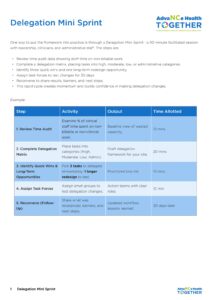
Downloadable Asset – 1.2.2 – Delegation Mini Sprint

The purpose of the task delegator is to help providers and managers categorize tasks based on complexity and necessary qualifications, ensuring safe reassignment while protecting clinical quality. Delegation allows clinicians to practice at the top of their license while empowering peers and support staff to contribute meaningfully.

Click to Download this resource

1.2.4-Monitoring-and-Refinement-Tool

The purpose of this worksheet is to ensure that delegation and workflow improvements don’t stop at the design stage. Monitoring is about consistently measuring performance and making refinements when gaps or new challenges appear. Effective monitoring helps teams sustain progress, avoid backsliding, and continuously improve.
Click to Download this resource

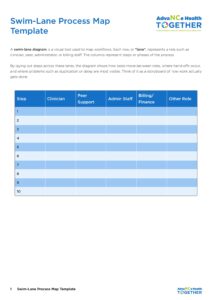
1.3.1 – Swim-Lane Template

A swim-lane diagram is a visual tool used to map workflows. Each lane represents a role such as clinician, peer, administrator, or billing staff. The columns represent steps or phases of the process. By laying out steps across these lanes, the diagram shows how tasks move between roles, where hand-offs occur, and where problems such as duplication or delay are most visible.
Click to Download this resource

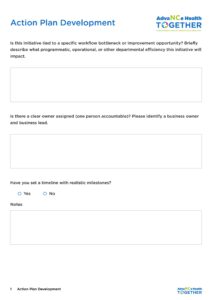
1.3.3 – Action PLan Development

Action planning is a systematic way to implement changes in an organization. They identify any potential issues to change and pave the way for the change to last and be continuously measured.

Click to Download this resource

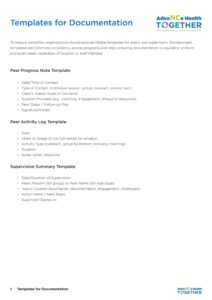
1.4.4 – Templates for Documentation

To reduce variability, organizations should provide fillable templates for peers and supervisors. Standardized templates also promote consistency across programs and sites, ensuring documentation is equitable, uniform, and audit-ready regardless of location or staff member.

Click to Download this resource

1.4.5-Performance-Metrics-Feedback-Loops

The purpose of this module is to show how programs can measure the impact of peer roles and use structured feedback loops to continuously improve. Metrics tell us what is happening; feedback loops help us refine how we respond. Together, they ensure that peer integration is not a one-time initiative but an ongoing cycle of accountability and learning.

Click to Download this resource

1.5.5-Improvement-Checklist

This improvement checklist will assist in the structured improvement cycle. Healthcare dashboards are powerful tools for visualizing key metrics, tracking performance, and supporting decision-making in clinical and administrative settings. But to ensure your dashboards remain relevant, accurate, and actionable, organizations should adopt a structured improvement cycle for continuous evaluation and enhancement. By embracing ongoing evaluation and refinement, healthcare organizations can maximize the utility and impact of their dashboards.
Click to Download this resource

1.6.2-Trillium-Sponsor-Assessment-Tool

This assessment evaluates employees on how well they are positioned to be a change sponsor. A change sponsor supports and leads organizational changes from beginning to end. There are a variety of factors that go into determining who best fits the role.

Click to Download this resource

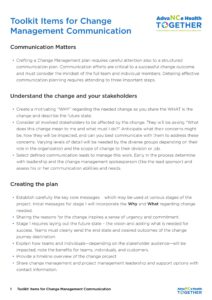
1.6.3 – Communication & Engagement Plan

This toolkit explains what is needed to create a change management plan. It gives requirements and advice that takes into consideration communication and stakeholders.

Click to Download this resource

Track 2: Financial Management Of Prospective Payment & Value-Based Reimbursement
2.1.4-CCBHC-Comparative-Analysis-Matrix

Understanding how different reimbursement structures shape clinical, operational, and financial performance is critical for CCBHCs. A simple comparative matrix helps learners identify who carries financial responsibility (The payer, the CCBHC, or both) as well as what strategic advantages or challenges arise for a CCBHC when moving from volume-based payment (fee-for-service) to capitated or prospective payment models. This knowledge drives stronger decision-making, promotes financial sustainability, and ensures high-quality, person-centered care.
Click to Download this resource

2.1.5-Governance-and-Negotiation-Checklist

Depending on the core area (domain being assessed), this checklist offers guidance on what to have in mind when negotiating rates. It also highlights factors of critical importance to each core area.

Click to Download this resource

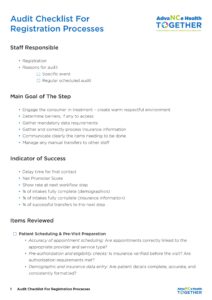
2.2.3-Checklist-for-Registration-Processes

This checklist is for ensuring registrations are happening as smoothly and effectively as possible. It calculates a score and tracks the trend compared with the last audit.

Click to Download this resource

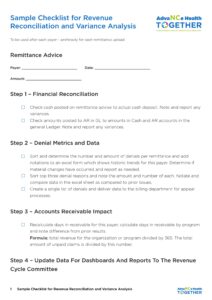
2.2.5-Checklist-for-Revenue-Reconciliation-and-Variance-Analysis

This checklist ensures that no necessary step is missed for each payer. Preferably for each remittance upload.

Click to Download this resource

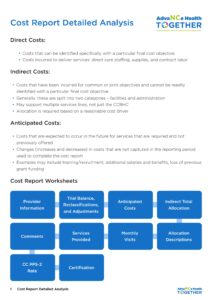
2.3.1-Cost-Report-Detailed-Analysis

This tool defines and give recommendations on how to manage direct, indirect, and anticipated costs. It also outlines cost report worksheets.

Click to Download this resource

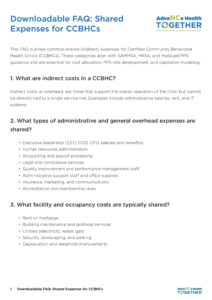
2.3.2 – Downloadable FAQ – Shared Expenses for CCBHCs

This FAQ outlines common shared (indirect) expenses for Certified Community Behavioral Health Clinics (CCBHCs). These categories align with SAMHSA, HRSA, and Medicaid PPS guidance and are essential for cost allocation, PPS rate development, and capitation modeling.

Click to Download this resource

2.3.3-CCBHC-Staffing-and-Encounters

This tool can assist estimating total number of FTEs by staff specialty and clinic size to ensure the CCBHC has adequate funding, patients receive timely access to CCBHC services and supports, and CCBHC requirements are met.

Click to Download this resource

2.4.2-Forecasting-tool

The purpose of the model is solely to display information that can be gathered with minimal effort and can project outcomes. This function allows one to make small adjustments before larger ones are needed. Strong organizations will want to use models that are substantially more elaborate and detailed than the one provided to ensure the most accurate results

Click to Download this resource

2.4.3-Quality-Metric-Reporting-format

The model is designed to show the standard reporting format for quality metrics. It is designed for ease of use and ease of understanding – both of which are key for quality departments using the data, It contains only two related variables. For clarity, others should be reported on other sheets. It also provides both numeric and graphic displays of results. visual graphic displays are generally better for understanding
Click to Download this resource

2.4.4-Withhold-Forecast-Template

This tool helps project financial outcomes under different performance scenarios (Worst Case, Base (Most Likely), Best Case)

Click to Download this resource

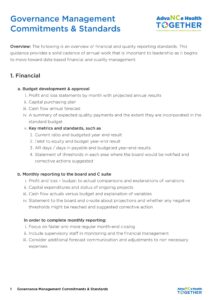
2.4.5 – Governance Management Commitments & Standards

The following is an overview of financial and quality reporting standards. This guidance provides a solid cadence of annual work that is important to leadership as it begins to move toward data based financial and quality management.

Click to Download this resource

2.5.2-2-x-2-scenario-planner

Both models in this file are ways to take the first step in scenario analysis, which is to define a series of scenarios that staff and others can react to and in calm and deliberate times make decisions that could be far more pressured in times of crisis. Both rely on a selection of variables. A variable is a driver or factor about the future that presently concerns you. The 2 X 2 matrices is a standard method that can be used quickly to create reasonably complex situations.

Click to Download this resource

2.5.3-Sensitivity-Analysis

Traditionally sensitivity analysis is keyed on one or at the maximum two variables. The variable is flexed by providing possible numeric outcomes and testing each for the likely financial outcome for each item. Sensitivity analysis works best on objective numeric values as its goal is to define objective outcomes. In this example the reduction in Medicaid referrals that are due to changes in eligibility is reviewed.

Click to Download this resource

2.5.4-Scenario-Analysis

This scenario analysis is based on combining two models. Likely these models were prepared by two different groups. The first group did the brainstorming of scenario planning and suggested a response of increasing productivity. As the work is different, the two groups likely did not meet in a single meeting. The second group added a new line for data entry. This line adds back increasing levels of productivity to replace the lost service volume. The two groups need to rely on the skills of each to assure that the amount of reductions and increases in service are both within possible ranges.
Click to Download this resource

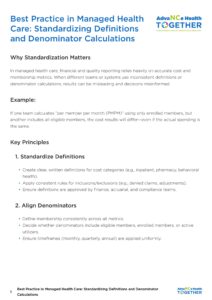
2.6.3 – Best Practice in Managed Health Care – Standardizing Definitions and Denominator Calculations

This explains how standardizing definitions and denominator calculations can improve managed health care. It also provides key principles and the value of having consistency.

Click to Download this resource

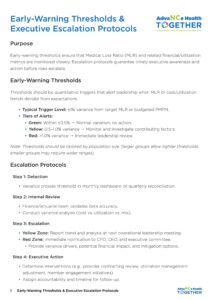
2.6.5 – Early-Warning Thresholds & Executive Escalation Protocols

Early-warning thresholds ensure that Medical Loss Ratio (MLR) and related financial/utilization metrics are monitored closely. Escalation protocols guarantee timely executive awareness and action before risks escalate. This tool reviews both.

Click to Download this resource

Track 3: Integrated Care Management & Care Coordination Excellence
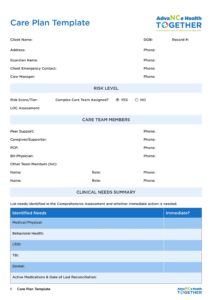
3.1.3 Care Plan Template

This is an example of what a Care Plan looks like with the fields needed ready to fill out. It also has comments and instructions for the different sections when filling out the Crae Plan. 

Click to Download this resource

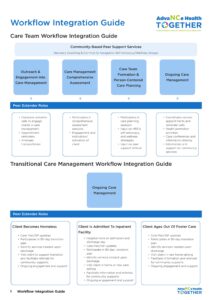
3.1.4 Workflow Integration Guide

This explains the different roles and responsibilities of the care team. It shows how to integrate these into one’s practice. It also outlines multiple situations and the responsibilities for each of them.

Click to Download this resource

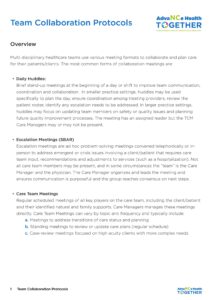
3.1.5 – Team Collaboration Protocols

Multi-disciplinary healthcare teams use various meeting formats to collaborate and plan care for their patients/clients. These are the common forms of collaboration meetings.

Click to Download this resource

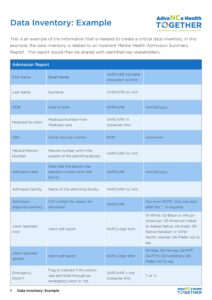
3.2.1 – Data Inventory

This is an example of the information that is needed to create a critical data inventory. In this example, the data inventory is related to an Inpatient Mental Health Admission Summary Report. This report would then be shared with identified key stakeholders.

Click to Download this resource

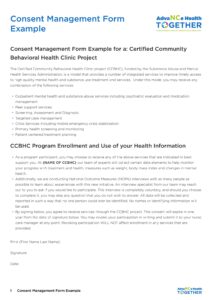
3.2.3 – Consent Management Form

This explains what the CCBHC project is to the people you serve. It explains how their information would be used and if that person is willing to share their information.

Click to Download this resource

3.2.4-Example-of-Tracking-Log

This is an example of the content that is associated with a tracking log. The use of this log assures that any access to systems is monitored and can be produced as needed for audit purposes.

Click to Download this resource

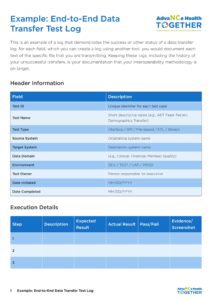
3.2.5 – Example – End to End Data Transfer Test Log

This is an example of a log that demonstrates the success or other status of a data transfer log. for each field, which you can create a log using another tool, you would document each test of the specific file that you are transmitting. Keeping these logs, including the history of your unsuccessful transfers, is your documentation that your interoperability methodology is on target.
Click to Download this resource

3.3.1 – Domain Integration Framework

This checklist shows at a high level what protocols should be in place depending on the domain of care.

Click to Download this resource

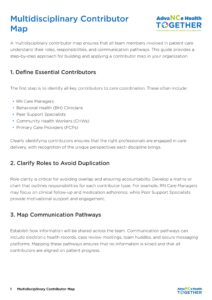
3.3.2 – Multidisciplinary Contributor Map

A multidisciplinary contributor map ensures that all team members involved in patient care understand their roles, responsibilities, and communication pathways. This guide provides a step-by-step approach for building and applying a contributor map in your organization.
Click to Download this resource

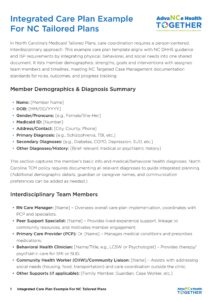
3.3.3 – Integrated Care Plan Example For NC Tailored Plans

This example care plan template aligns with NC DHHS guidance and ISP requirements by integrating physical, behavioral, and social needs into one shared document. It lists member demographics, strengths, goals and interventions with assigned team members and timelines, meeting NC Targeted Case Management documentation standards for roles, outcomes, and progress tracking.
Click to Download this resource

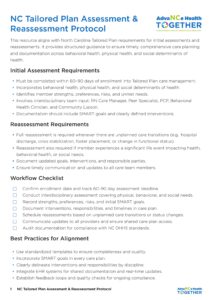
3.3.4 – NC Tailored Plan Assessment & Reassessment Protocol

This resource aligns with North Carolina Tailored Plan requirements for initial assessments and reassessments. It provides structured guidance to ensure timely, comprehensive care planning and documentation across behavioral health, physical health, and social determinants of health.
Click to Download this resource

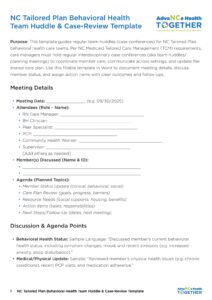
3.3.5 – NC Tailored Plan Behavioral Health Team Huddle & Case-Review Template

This template guides regular team huddles (case conferences) for NC Tailored Plan behavioral health care teams. Per NC Medicaid Tailored Care Management (TCM) requirements, care managers must hold regular interdisciplinary case conferences (aka team huddles/planning meetings) to coordinate member care, communicate across settings, and update the shared care plan.
Click to Download this resource

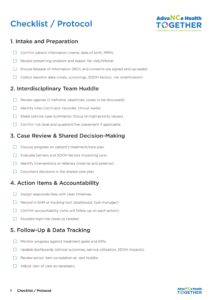
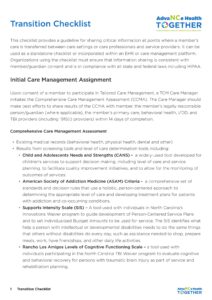
3.4.4 – Transition Checklist

This checklist provides a guideline for sharing critical information at points where a member’s care is transferred between care settings or care professionals and service providers. It can be used as a standalone checklist or incorporated within an EHR or care management platform.

Click to Download this resource

3.4.5-Performance-Monitoring-Audit-Asset

This tool demonstrates the metrics and components for developing Key Performance Measures for various standards in the CCBHC and TCM programs. It is intended to support organizations in monitoring their own performance and preparing for audits by regulatory entities.

Click to Download this resource

3.5.1-Outcome-measure-definition

This tool shows some of the major mental health scales and defines the values and scores for each

Click to Download this resource

3.5.2-Dashboard-w-Dynamic-Benchmarking

This dashboard tracks key CCBHC domains using current performance data compared to NC, national, and peer benchmarks.

Click to Download this resource

3.5.2-Dynamic-Benchmark-configuration

The CCBHC Criteria Assessment is designed as a performance improvement resource to help engage CCBHCs in a self-reflective process specific to enhancing the criteria required for a Certified Community Behavioral Health Clinic (CCBHC). It is designed primarily as a performance improvement resource to increase an organization’s awareness of the CCBHC criteria and to engage in a self-reflective process that assists in identifying action steps moving forward.
Click to Download this resource

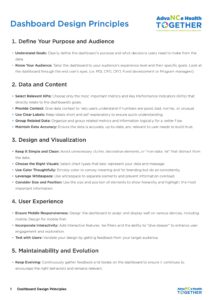
3.5.3-Dashboard-Design-Principles

This tool explains principles that should be considered when creating dashboards that monitor progress and performance.

Click to Download this resource

3.5.4-CCBHC-ETL-Dashboard-Automation

This tool describes an automated ETL framework to extract, transform, and load data from EHR, billing, and survey systems to dashboards with near real-time accuracy.

Click to Download this resource

3.5.5-Data-Flow-Steps

This data flow is an example of how to engage your stakeholders, develop an approach, and build something that is informative, so the information is actionable. Data flows can improve outcomes, efficiency, increase compliance, and more.

Click to Download this resource

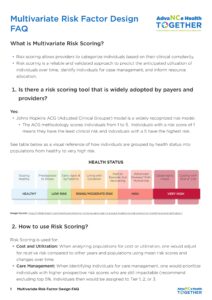
3.6.1-Multivariate-Risk-Factor-Design-FAQ

This FAQ sheet explains what risk scoring is. It then describes best practices for its implementation and maintenance.

Click to Download this resource

3.6.2-Risk-Stratification-Panel-Management

This tool defines multiple tiers of risk. By developing these tiers, organizations can tailor individualized approaches for outreach and engagement based on the individual’s risk factors

Click to Download this resource

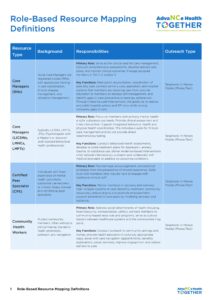
3.6.3 – Role-Based Resource Mapping Definitions

This tool highlights resource types, their responsibilities, and the types of outreach it is suggested they should conduct.

Click to Download this resource

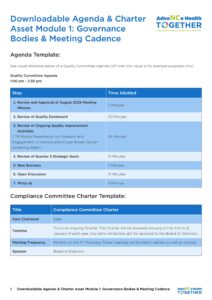
3.7.1 – Downloadable Agenda & Charter Asset

This is an example of how an agenda could look for an organization’s Quality Committee. A Compliance Committee’s charter template is also provided.

Click to Download this resource

3.7.2-Compliance-Milestone-Calendar-Downloadable-Asset

This table acts as a calendar for compliance requirements. Use it to help map and prioritize activities to achieve continuous compliance.

Click to Download this resource

3.7.3-Escalation-Triggers-Tool

This tool shows depending on the trigger and reason, what the risk level is and who should be assigned to escalation.

Click to Download this resource

3.7.4-Quality-Dashboard-2-examples

These are examples of different quality dashboards in simple ways to make improvement and maintenance of one’s business practices and care management easier

Click to Download this resource

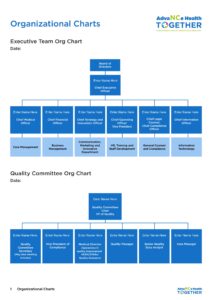
3.7.5-Organizational-Charts-Downloadable-Asset

These are models for organization by department to ensure all business functions are managed appropriately.

Click to Download this resource

Track 4: Technology, Data Architecture & Performance Management

4.1.1-Data-Domain

This is an example of how to stratify your data into different domains and what additional information is included so anyone that reads your data domain understands.

Click to Download this resource

4.1.2-RACI-Model-Data-Management

This model is to help assign responsibility depending on the task. It is an effective model of project management that translates well into data management.

Click to Download this resource

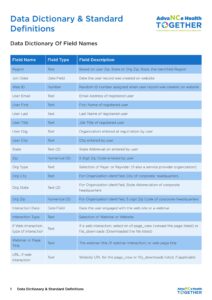
4.1.3 – Data Dictionary & Standard Definitions

This example of a data dictionary can be used in your organization to best capture each field, its format, and description. The goal is to have a comprehensive list anyone can read and understand.

Click to Download this resource

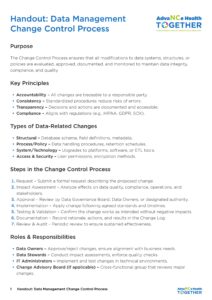
4.1.4 – Handout Data Management Change Control Process

The Change Control Process ensures that all modifications to data systems, structures, or policies are evaluated, approved, documented, and monitored to maintain data integrity, compliance, and quality.

Click to Download this resource

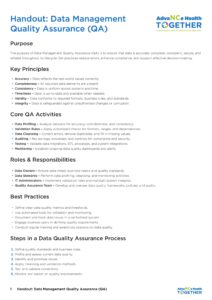
4.1.5 – Handout Data Management Quality Assurance (QA)

The purpose of Data Management Quality Assurance (QA) is to ensure that data is accurate, complete, consistent, secure, and reliable throughout its lifecycle. QA practices reduce errors, enhance compliance, and support effective decision-making.

Click to Download this resource

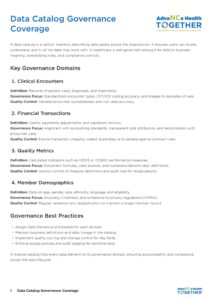
4.2.1 – Data Catalog Governance Coverage

A data catalog is a central inventory describing data assets across the organization. It ensures users can locate, understand, and trust the data they work with. In healthcare, a well-governed catalog links data to business meaning, stewardship roles, and compliance controls.

Click to Download this resource

4.2.2-Data-Governance-Roles-and-Responsibilities-

Roles ensure data is defined consistently, validated accurately, and protected effectively. Effective data governance depends on clearly defined roles and responsibilities. Assigning ownership, stewardship, and technical administration ensures that data definitions, quality checks, and approvals are performed consistently and transparently across the organization.

Click to Download this resource

4.2.3-Crisis-Response-Time-Tracker

Use this tool to track your crisis calls, response time, and how often you were within standard.

Click to Download this resource

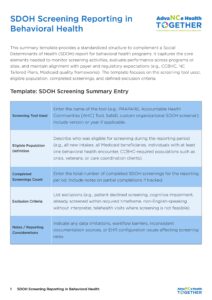
4.2.4 – SDOH Screening Reporting in Behavioral Health

This summary template provides a standardized structure to complement a Social Determinants of Health (SDOH) report for behavioral health programs. The template focuses on the screening tool used, eligible population, completed screenings, and defined exclusion criteria.

Click to Download this resource

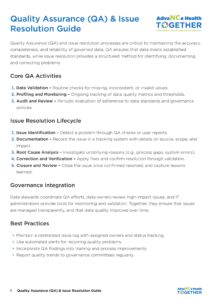
4.2.5 – Quality Assurance (QA) & Issue Resolution Guide

Quality Assurance (QA) and issue resolution processes are critical to maintaining the accuracy, completeness, and reliability of governed data. QA ensures that data meets established standards, while issue resolution provides a structured method for identifying, documenting, and correcting problems.

Click to Download this resource

4.3.1-CCBHC-Comparison-Matrix

The CCBHC Criteria Assessment is designed as a performance improvement resource to help engage CCBHCs in a self-reflective process specific to enhancing the criteria required for a Certified Community Behavioral Health Clinic (CCBHC). It is designed primarily as a performance improvement resource to increase an organization’s awareness of the CCBHC criteria and to engage in a self-reflective process that assists in identifying action steps moving forward.
Click to Download this resource

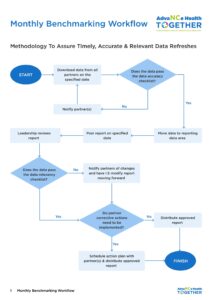
4.3.4 – Monthly Benchmarking Workflow_

This workflow helps with the methodology to assure timely, accurate and relevant data refreshes.

Click to Download this resource

4.3.5 – Accountability & Continuous Improvement_

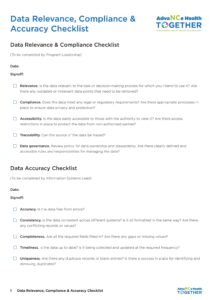
This checklist assists program leadership in ensuring data accuracy and other factors critical to the management of the program’s collected information.

Click to Download this resource

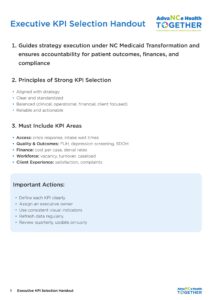
4.4.1 – Executive KPI Selection Handout

This handout assists leadership in selecting the right KPIs for their program which will impact the outcomes of the people they serve.

Click to Download this resource

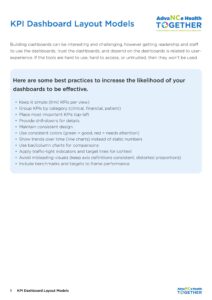
4.4.2 – KPI Dashboard Layout Models

This handout provides some best practices to increase the likelihood of your dashboards to be effective.

Click to Download this resource

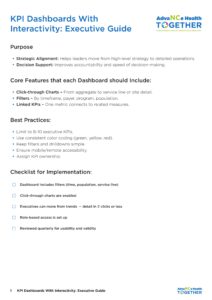
4.4.3 – KPI Dashboards With Interactivity_ Executive Guide

This guide helps leaders gain strategic alignment and decision support when building and maintaining their KPI Dashboards.

Click to Download this resource

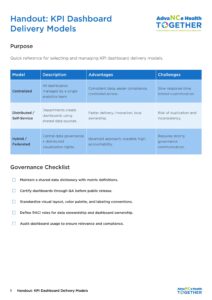
4.4.4 – Handout_ KPI Dashboard Delivery Models

This is a quick reference for selecting and managing KPI dashboard delivery models.

Click to Download this resource

4.4.4-How-To-Best-Deliver-KPI-Dashboards-For-Leadership

These are a list of main delivery options of KPI dashboards with strengths, limitations, and best uses. Effective delivery of KPI dashboards depends on choosing the right method to assure that leadership will use the information. Executives need access to timely, actionable, and clear information in formats that fit their workflow.
Click to Download this resource

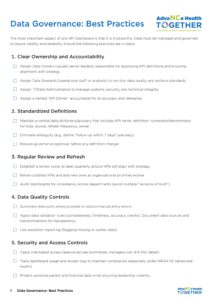
4.4.5 – Data Governance Best Practices

The most important aspect of any KPI Dashboard is that it is trustworthy. Data must be managed and governed to assure validity and reliability. The following checklist helps to ensure the right practices are in place.

Click to Download this resource

4.5.1-CCBHC-Quality-Metrics-Evaluation-Table

This contains present CCBHC quality metrics in a format that can be used by an organization to determine if they should be selected for incentive payment.

Click to Download this resource

4.5.2-Bonus-eligibility-forecasting

This model is a sample of how to present rolling forecasts and use them to verify the plausibility of the work. Both the “Historical By Quarters” tab and the “Current Monthly Data” tab show data for a fictitious entity over time and uses that information to be more certain of their coming forecasts.

Click to Download this resource

4.5.3-Quality-Bonus-Incentive-Data-Executive-Report

This model is a sample method for displaying monthly calculations of bonus incentive and providing them for review and adjustment by senior leadership. The sample page provides all the data needed for determination of next steps including the metric, the payment method, the benchmark needed for success, the prior historic rate that the company applied, and the actual YTD number.

Click to Download this resource

4.5.4-3-Key-Scenarios-for-frorecasting-options

This model indicates the three key scenarios that should be used when considering forecasting options. The “Current Monthly Forecast” tab from the Bonus Eligibility Forecasting asset is used as an example.

Click to Download this resource

4.5.5-Executive-Board-Reporting-Framework

The following provides a structured reporting framework for executive leadership, ensuring that key financial and operational data is presented clearly and supports informed decision‑making.

Click to Download this resource